Latest Posts

Julie Casey | Milliner

The idea of leaving her career in banking had been floating around in Julie Casey’s head for some time. More time with her only son, Ben, and a change of direction were top of her list.
Looking for something to do from home, Julie began testing the waters with a few millinery courses in Melbourne, the epicentre of the trade in Australia. She had begun to enjoy her new creative outlet, but it was a family accident eight years ago that finally forced her hand and cemented her decision.

Aged seven and a half, Ben’s right foot got run over by the family’s ride on mower. It had to be amputated, and a prosthetic limb put in its place. Julie took three months’ leave to care for Ben and her mind was made up.

“I said, ‘yep, that’s it.’ I wanted to be at home. It’s only a short time that your kids are with you, and I’ve only got one.”

Growing up in Byron Bay, Julie and her husband, Paul, met at high school in Mullumbimby and moved to Clunes to build their own home thirteen years ago. This time of year, leading up to the spring racing carnivals, Julie is at her busiest. There are regular clients who get a hat made each year, plus fashion parades and shops to supply with her striking pieces.

“I like to do things that are unusual and different, starting with a base and creating from that”, Julie says. “Generally where we start is the dress, the shoes and the bag.” A customer’s preferences and the properties of the various materials are crucial in the initial design stage, but from then on Julie is relatively free to come up with a one-off design.

“You can’t force something to do something it’s not supposed to”, she says of the different materials and objects used in millinery. Feathers, straw, ribbon, silk, lace, felt, netting; some are easier to work with than others. “I do love shaping with feathers because it’s a fairly instant result, you can get something dramatic pretty quickly”.

Julie shows off a large, brightly coloured headpiece of hot pink and Gatorade-orange feathers. It only took about 6-8 hours to make, while others have up to 20 hours of work involved, with hand stitching, wiring, shaping and stiffening the fabrics before adding the trims. “But it’s fun!” beams Julie, “and it’s exciting when you finally get to the end.”

Millinery trends closely follow changes in fashion, but some ideas are slow to shift. For the uninitiated, the traditional spot to wear your hat, or fascinator, or headpiece, or even ‘hatinator’, yes, it’s a word, is on your right temple. Recently, milliners have begun to break away from positioning hats on the side, says Julie, led by British milliner to the stars, Philip Treacy, after he caused a stir with his hats worn in the centre of the forehead by guests at the royal wedding in 2011.

Because each hat is a one–off, it’s forbidden to copy other milliners’ creations, Julie says. “To really broaden what you do, you need to do as many courses as you can with different milliners, because they all teach differently and they all teach different techniques they’ve created themselves.” Julie has gathered skills from workshops with many milliners over the years, including well-known Australian milliners Louise McDonald and Neil Grigg.

As well as designing and making headwear from her home workshop in Clunes, Julie and her husband have recently bought a joinery business in Lismore, which is taking up a lot of her energy at the moment. It’s part of the family’s future planning, and also another string to Julie’s bow.

“It’s good to mix it up and do different things throughout your life. I couldn’t imagine being stuck in the same building with the same people for 30 or 40 years.”

Back In My Good Books: A Story About Discovering Irish Authors In Cyberspace

I have previously written about my sense of malaise at not being able to remember what I was supposed to look up online, and about being underwhelmed by the web when I use my phone instead of my computer. I was annoyed with myself that my web surfing had been reduced to quick scrolls with a finger instead of delving down rabbit holes of wonder, and I was always being distracted by what was coming at me via email and various social media channels. My fault entirely, but still hard to get over.

To overcome this, I have been consciously trying to go directly to webpages which I love, or blogs which make me happy, to see what’s happening there. That way I get to see stuff I am choosing to see, rather than the stuff choosing to see me (I’m looking at you, facebook).

Recently I found this post on one of my favourite sites, Meet Me At Mikes, and it took my eye because of the reference to a podcast with the children’s book author, Oliver Jeffers. We own two of his books, with their immediately recognisable illustrations and their grown up concepts woven into enthralling tales for kids.

Pip’s post on Meet Me At Mikes is about the beauty of being oneself, and not trying to be the same as everyone else. But more than that, and something which resonated with me, it was about the idea of backing yourself. Coincidentally, when my 2015 diary asked me for my New Year’s Resolutions, I had written exactly that. ‘Back Myself’. Such a simple instruction, but one that’s so easily forgotten, or worse, consciously deleted from our self-talk.

In the podcast (here), Oliver Jeffers speaks about the way that each person’s handwriting is different, and expands the idea to apply it to art and even the way our brains work.

“If you didn’t have your own handwriting everything would look just like it was printed in a book”, he says. “Everybody’s got their own little quirks and tweaks that make it theirs. And it’s the same with drawing and probably the same with thinking.”

I look at my handwriting in my desk diary open in front of me and notice the letters slightly slanting to the left at times, sometimes narrow vowels and curves, at other times more rounded. Apparently even my handwriting can’t manage to be the same as my own handwriting.

…But back to Oliver Jeffers. His point is that we all have our own styles, and we should try to embrace what sets us apart from others, instead of trying to be the same. At a point, Jeffers realised he needed to stop copying what other artists and illustrators were doing, and let his hands draw the way they wanted to. It was then that he discovered his own style which came so easily and enjoyably, and in turn others came to love it as well. I love the realisation that imitation was pretty futile in his line of work, “somebody’s already doing that for a living, and it’s that guy”.

My own discovery that Jeffers has a life outside of kids’ books (he’s a painter and filmmaker as well) was just another gem I found on this little rabbit-hole adventure. And, as if this weren’t enough treasure for one day, thank’s to Pip’s post I also found out about another great site, Brain Pickings. It is, in it’s own words, a cross-disciplinary LEGO treasure chest, full of pieces spanning art, science, psychology, design, philosophy, history, politics, anthropology, and more. I think I’ll be visiting there in the future. Type it straight into the address bar, do not pass Go.

So, I am back loving the internet, and not just because I have found 7 different posts about how to hide veggies in my toddler’s smoothies, dinner, dessert, cupcakes, carpets. Sorry, that last one wasn’t online. That was in my actual house.

Related post: Why it’s hard to surf after a feed

John Stewart and Leonie Lane | Creatives

When government arts funding was slashed and courses cut from TAFE campuses two years ago, ceramicist John Stewart went back to his first love. At the time he was head teacher of Creative Industries at Lismore TAFE, and he left a long and successful teaching career to get back to his workshop outside Clunes.

John discovered ceramics as a teenager, teaching himself the techniques from books. When he chose it for his Higher School Certificate his teachers were surprisingly supportive.

“Everyone was so relieved because I was a dreadful painter!” he says.

John and his father made his first pottery wheel, and with books and practice, John honed his skills at ‘throwing’ (working clay on a potter’s wheel). “They say it takes seven years to get good at throwing”, he says, but these days his work uses other techniques, and throwing is more of a love.

John’s partner, Leonie Lane, also recently left a teaching career to pursue her own art full time. Until January this year, Leonie taught Digital Art and Design at Southern Cross University, but is now acclimatising herself to days without timetables and tutorials, working from her home studio.

The couple live and work in the old dairy on what was John’s parent’s farm, which they’ve converted into a residence and several modern studio spaces for pottery, photography and art. John and Leonie both have strong family ties to the area. From the front fence of their place you can see John’s parent’s old house and his grandmother’s, and if you continue down to the valley to Booyong you’ll eventually come across the old village shop run by Leonie’s grandfather years ago.

A graphic designer and visual artist, Leonie grew up in Eltham before studying art in Melbourne and working in Sydney at well-known alternative print and design studio, Redback Graphix, and as a freelance illustrator. Today her work combines digital imagery with print, but she’s also experimenting with elements of the natural environment, such as horsehair, sewn onto her works. “I’m working with digital images but making them look hand made”, Leonie says.

Her latest project is a series entitled Shedding, exploring the idea of de-institutionalising. It will feature in an exhibition at Grafton Regional Gallery in August.

Both John and Leonie’s art forms incorporate aspects of modern technology, such as computers and photography, combined with traditional artistic disciplines.

“The digital side of things give you a different tool set to work with”, says Leonie of the intersection between the two. She also enjoys the freedom and accessibility that technology offers the artist. “The beauty of working with prints is that you can make many copies. It’s the democratisation of your art.”

John’s current project, a series of slip cast vases with test tube inserts, is an example of the close relationship between technology and craftsmanship in his field. With their smooth white surfaces and delicate artwork, the vases are a world away from many of his large, earthy sculptural pieces that adorn his garden and workshop. The process of pouring liquid clay, or ‘slip’, into a plaster mould is hundreds of years old, but the integration of glass tubes and aluminium housings in the vases is made possible by the magic of computer design software.

As well as their individual projects, the couple are collaborating on a range of ceramic bottle tops that stop insects getting in your beer after it’s open. Using John’s slip casting technique and Leonie’s design and graphics expertise, they are manufactured and sold from their studio and online under the No Fly Zone brand.

Acrophobia Or Something Like It

It was the Giant Drop at Dreamworld that undid me. Sitting, waiting, nothing out in front, nothing below. Only a metal harness preventing me from free-falling 39 storeys onto concrete and fake rocks below.

I wanted to get off. I couldn’t. I pressed my back into the plastic seat as far as it would go. I didn’t speak. When the carriage was released we rushed to the bottom, gut-in-throat, and I vowed never to go on it again. I’ll be sticking to the pirate ship, me hearties.

I wasn’t always this paranoid about heights but it’s getting worse. It’s no wonder theme parks aren’t built for adults to enjoy, when your aversion to risk is properly formed and your body’s equilibrium is so easily disturbed. But what about climbing the bell towers of medieval European churches? The Sydney Harbour Bridge Climb? Surely people past puberty can tackle those? Perhaps I just pushed it too far, did one too many. These days I barely want to go above the 3rd floor in a high rise.

Recently I took my family to a waterfall where a lookout juts out from the rock bed and lets you view the massive cascade as if you are standing out in front of it. The drive there is a single lane, winding road up the ridge encircling the valley. In places the rainforest is thin enough to see through, and you can look out between the trees across the gaping void and to the rock-faced cliffs on the other side. It gives me the creeps.

I could feel my heart beating louder in my ears and felt my breath quickening.

“Why do I do this to myself?,” I said aloud.

The viewing platform hangs out above the treetops and way down below you can see hikers stopping for a picnic at the base of the fall 100 metres below. The walking path is on the same level as the rocky creek bed before the ground falls away, and at a certain point it’s quite easy to climb over (or under) the waist-height steel railing and walk out to the edge of the slippery cliff where the water runs over.

On the day we visited, some idiots, sorry, teenagers, were out there. I could have screamed at them, but instead I tried to divert my toddler’s eyes away, hoping he wouldn’t notice the possibility and ask to join them. He did.

Acrophobia is defined as a “pathological fear of heights”. Looking up pathological, you find phrases like “caused by or involving disease”, “evidencing a mentally disturbed condition” and “any deviation from a healthy, normal condition”. Excuse me? I’d say it’s pretty normal to be afraid of not having stable ground on which to walk. Pretty normal to wish not to be near a cliff off which one might slip off nothingness.

The crux of my problem is the abyss under my feet, and the feeling of being out beyond with nothing between myself and the view. There’s a power that comes with being stuck out there, the power of life and death, and a measly little railing is big-upping itself if it thinks it can suppress it.

Give me a mountain to climb up, a rickety old staircase jutting out the side of a hiking track and I’ll scramble up there like a mountain goat. At least then I’m sticking to solid rock and I am within and surrounded by things bigger than myself. I’ve been jetty jumping, I get the thrill of it. Your heart rising to your throat as the water takes that split second longer to engulf you than you imagined. But dropping a few metres into water won’t kill you, while falling off a cliff probably will. Even a mentally undisturbed person knows that.

Emily and Andrea Bonotto a.k.a. Il Carretto

Take 2 parts husband and wife, 1 part Naples sourdough starter and 1 part self-belief. Add 1 wood-fired oven on wheels, a warm Bexhill evening and 50 kids untethered. Combine gently with a flexible spoon and knead regularly for 3 years. Turn out onto a well-worn village hall and enjoy with friends.

If you asked a 17-year-old Andrea Bonotto what he’d be doing today, he probably would have said ‘working in the restaurant at my parent’s ‘otel’. Growing up next door to their hotel in Vicenza, north-eastern Italy, working for the family business seemed certain until his father sold it and Andrea was left wondering what to do. Low paying warehouse jobs, a transcontinental pilgrimage and a teaching degree later, he is back doing what he knows. “It would have been a lot cheaper if I went straight there”, he concedes with a smile.

After a breakup, a holiday to Brisbane in 2001 seemed a good escape. At a pub, Andrea met Emily Lockton, and in 2006 the couple moved back to Bexhill, Emily’s hometown, to both attend university. When their son, Jack, was born in 2007, Emily quit her environmental science degree and started her own business sewing kids clothing and nappies, which she sold at markets.

Andrea says that Emily is the organisational one, and she’s constantly coming up with new business ideas. So, with her encouragement and market experience, Andrea’s secret pizza dough recipe and $5,000, the two launched their trailer-towed, wood-fired oven pizza concept. Initially selling at markets, Il Carretto began doing community pizza nights in Bexhill three years ago.

“We said if we sell 20 pizzas we’ll be happy, ‘cause we just live down the road.” They sold out that first night. And the next.

“It’s hard living and working together, but at the same time I wouldn’t have it any other way”, says Andrea. Being self-employed also allows them the flexibility to spend time with their two children, Jack, now 7, and Francesca, 4.

Andrea is aware of what he’s left behind in order to build a life here. Naturally, he misses his family and his hometown, and there’s also Asiago, with its snow-covered mountains, where he holidayed for many years, and where Il Carretto’s pizza recipe comes from.

Andrea is appreciative of the freedom and possibility that exists in Australia. “Here I have the opportunity to go to uni and have a family and buy a house at the same time”, he says, adding that the support of Emily’s family has been essential. There are some aspects of life here that still present a challenge, though. “I’m scared of the bush and the ocean”, laughs Andrea, hoping that some expeditions in their new camper trailer will soon help rectify that.

The pizza nights in Bexhill and Clunes are now reassuringly busy each week. In a country where the town square is more food-court than pigeon-filled fountain, the community has embraced these unstructured, European-style get togethers. Little tribes of kids running around, adults relaxing on rugs, no separations of age or income.

“You know, we only come and do the pizza. It’s what people make it”, says Andrea. “Bexhill pizza has become it’s own thing, it has it’s own life. Sometimes I think if I stopped doing the pizza there, people would still gather there and just bring their own stuff.”

He grins as though that would be the ultimate validation of what he and Emily have been working on. Their efforts have been rewarded with friendship, which Andrea likens to an extended family.

“I like to see my regular customers, I worry when they don’t come”, he admits. “Some call me to say they’re not coming, some stop by to say ‘we’re not coming tonight’. I mean, you don’t have to tell me! But it does feel nice.”

A Piece of Work

I get sideswiped by doubt each time I think about calling my next interviewee. What if they’re not home? What if they are but they say ‘no’?  What if they say ‘yes’?

I just pick up the phone and dial, no thinking, no hesitating. It’s got to be done. Otherwise I would never write another profile. I must.

Today I show up at the arranged time only to find my subject not at home. I should have called in the morning to re-confirm. I thought to, but didn’t. What if they had wanted to back out at the last minute?

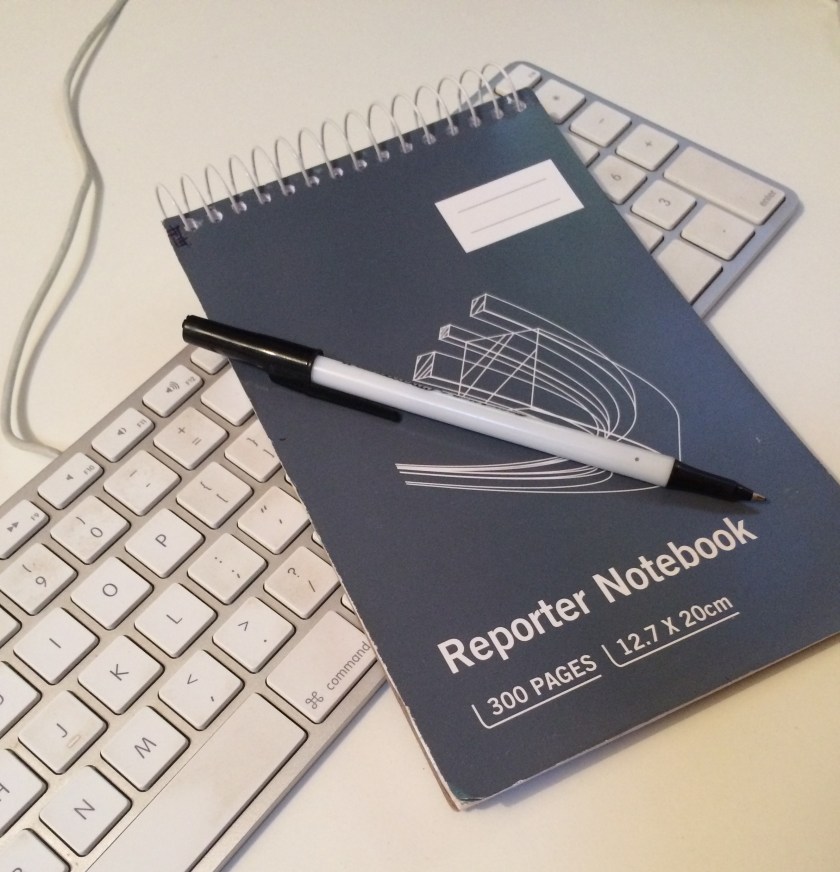
I’ve got my reporter’s notebook with my questions written out. And my pen. But my shorthand is that bad (where bad means non-existent) and I never leave enough space to scrawl down the answers fast enough, so I just end up recording the whole conversation each time.

I wonder if she’ll think I’m an upstart? I am quite a bit younger than her, and not nearly so experienced in anything at all. I wonder if she’ll be able to tell that I’ve had a shocker week: sick kids, daylight-savings-ending-induced hunger tantrums, midnight coughing fits that have given me bloodshot eyes. I don’t even own makeup heavy enough to cover up that kind of baggage these days.

Just be confident. I’m the one asking the questions.

Oh good, here she comes now.

Yes, it was today, that’s right. So sorry. Shall I come back another time? No, now’s fine. Let’s go inside and have a cup of tea. Anxiety ebbing away slightly.

Remember not to interrupt while she’s speaking, and don’t finish her sentences. I am prone to that.

So glad I looked up those last-minute election results before I came. At least I will look well-researched if we come to that.

Tea is going down well. Trying to keep the conversation moving onto things I want to ask without seeming pushy.  Remember to get the facts first time round. I don’t want to have to clarify someone’s age via email afterwards because I was too caught up in the anecdote.

Well, I won’t keep you any longer. Thank you so much, lovely to talk to you. Oh, can I take a quick picture? Perhaps just over there. I’m not making the mistake of forgetting to take a photo this time. I even wrote it down in my notepad. PHOTO

Back in the car I realise my underarms are sweaty. It’s a cool autumn evening. I’m on a high from having survived once again. Nothing like the feeling of finishing something that you at once look forward to and dread.

I think there’ll be some good quotes. There’s a little revelation or two of character that I can work with. Such an interesting life. I already know it will be a task to distil it down to a mere 600 words.

The recording is like a great weight anchored to my phone. It waits for me to uncouple it and release it to take shape on my computer, but it’s big and heavy.

No-one’s making me do this.

I avoid it for several days. Finally I’m at my keyboard, hating this feeling that all I have gleaned and all that’s been offered can never be properly rendered for others to know.

I differentiate and delete parts of her story. How unfair to a life. Though, without that editing I doubt the piece would be worth reading, and then what’s the point?

Are there too many dates, not enough emotion? Still, the thing needs bones or it just flops about. Maybe there’s room for a bit more about motivations. My brain hurts.

That paragraph would work better near the start. It’s flowing nicely now. An angle, some meaning, an essence. Man, how did it get so late?

Print.

Send.

Could have included that quote. Too late now.

At least I remembered to take a photo.

Satisfaction.

Katka Adams | Artist

When Katka Adams and her mother arrived in Australia as refugees they didn’t speak a word of English. It was 1969 and Katka was seven years old. Escaping the political repression of communism in Prague, Katka and her mother moved through several migrant hostels, including Bonegilla near Albury-Wodonga, before settling in Melbourne.

“They just stuck me in a class of regular kids. I had to relearn my whole way of writing, and I didn’t understand what the words meant”, says Katka, in her now strong, easy Australian accent. The language barrier meant Katka spent a lot of time alone drawing, even as a young child, and developed a fondness for art that never wavered.

Finishing high school in Sydney, Katka had her heart set on going to art school.

“The career adviser said, ‘You’ve really got to look at your other options’, and I said, ‘what other options, there are no other options!’”

It is now 20 years since Katka and her husband, Russell, bought their small settler’s cottage on the eastern edge of Clunes. From her home studio, Katka looks out across their 11 acres of established fruit trees and rainforest, across the valley to the hills that hide the coast from view. Working on only one piece at a time, and having to complete it before beginning the next is a way of ensuring her drawings get finished at all. The anticipation of seeing what will emerge on the blank page motivates Katka.

“It’s like a reward”, she says. “It’s not really about the finished product, it’s more about the process”.

Katka gushes with enthusiasm for the craft of drawing, and of self-expression. For aspiring artists, and especially young people, she says the key is simply to just keep drawing. “Don’t have some kind of expectation”, she warns. “Don’t think, oh, it won’t be good enough, or I’ll never be that good, but it’s not about that.”

Even surgeons, Katka tells me, have been told that practicing drawing will improve their surgery. Amazingly, a study published in January in the journal NeuroImage actually observed this phenomenon, where subjects taking a drawing or painting course showed an increase in creative thinking skills and altered brain structure after three months compared with those not taking art.

Russell, a doctor, draws beautifully, says Katka. And their three children are quite creative, too. Having started their education at Clunes Primary School, they are each now carving out their own niche in the world. Millie, 30, studied costume design at NIDA and has worked with Bangarra Dance Theatre. She now lives in Brisbane and has a 4-month-old daughter, Olive.

At 27, their son, Tom, has recently finished a Photovoltaic Engineering degree but has just taken up knitting. Katka darts off to procure a large, knitted Humpty Dumpty stuffed toy that he’s made for Olive. As a knitter, I can tell it’s flawless, and I can’t stop smiling at it. Sophie, Katka’s youngest, has inherited her parents’ gift for gardening, and is propagating succulents all over the verandah, trays of cuttings laid out in varying stages of rebirth.

Katka’s still-life drawings are often light, delicately rendered images of every day items. An exquisite scone laden with jam and cream, a gold-rimmed teacup, a pair of slippers beneath a perfectly made bed. Animals also feature prominently in several of her collections, where hens, lambs, birds and dogs appear in imaginative and surreal domestic scenes. But sometimes the pictures end up surprisingly sombre, and their meanings only become clear long after completion.

“Some of the drawings have a little bit of darkness to them, but that’s what there is in life, you know. There’s a little bit of dark and a little bit of light.”

Jim and Doris Armstrong | Community Champions

James Byron Armstrong will tell you that one thing can change a person’s life. For him, that moment came in 1969 when he was elected to the now defunct Terania Shire Council by just one vote.

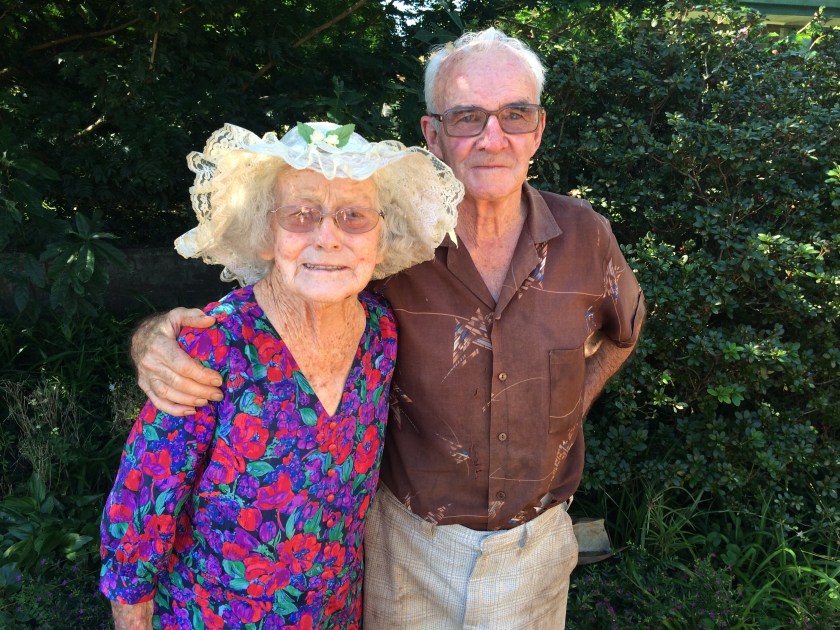
Keen to accurately champion the needs of his new constituents, Jim needed a way to connect with them. “I decided to do something in every district, so I knew what the people wanted”, he says. Already playing table tennis at Dunoon, he took up bowls at Rosebank, and started attending euchre in the under croft at Clunes Anglican Church. It was at euchre that he met Doris Warburton, and in time Jim was invited to go dancing with her group of friends at the Casino RSM club. They married, both for the second time, in April 1974.

Jim’s only daughter from his first marriage had returned to Sydney with her mother, and Jim moved in with Doris at her Walker Street home. Now 94, Doris attended primary school at Clunes, and has given much of her life to serving the community, most notably as a member of the Clunes Hall committee. Although now suffering dementia, Doris still plays cards each week in the same room where she and Jim met over 40 years ago. “She still plays euchre pretty good”, beams Jim. “Gets mixed up with the bowers, but they all help her out a bit”.

Growing up in Dorroughby, originally known as Glen View, Jim first entered public life as a teenager when his father, James Osman Armstrong, asked him to represent the family at local meetings. Jim’s unwavering sense of public responsibility was fostered at a young age, seeing his father help build the Glen View Sunday School, now the Dorroughby Hall. Community spirit still oozes out his every pore, even at age 79. “I’m still trying to do my best to help our community and citizens”, he says with vigour.

These days Jim’s time is divided between caring for Doris and managing the Goonellabah Table Tennis Centre, where he still plays twice a week. For a man who has dedicated much of his life, and his own personal finances, to the game, he laughs when he recalls that when a friend first introduced him to the sport in the mid 1950s, he didn’t win a game for 3 months. In 1957 Jim helped form the Far North Coast Table Tennis Association, which brought together clubs from Rock Valley, Casino, Federal, Alstonville and everywhere in between. Each club took it in turns hosting team competition nights on their own turf. “They were fun nights, that was the best”, he says.

“Happiness is being thankful for small mercies. And I’ve had lots of them”, says Jim.

He recounts a particular accident in which he fell off macadamia machinery onto his head. “‘You shouldn’t be here’, the doctor said”. Jim subsequently sold his plantation at McLeans Ridges and used most of the money to build the table tennis centre at Goonellabah. Today that centre has international-standard tables and the actual floor used at the Sydney Olympics in 2000. Driven by a desire to see others enjoy the game as much as he does, Jim has also donated countless tables to schools and organisations in the Northern Rivers. He is quite serious about providing opportunities for others to have fun. “If you can’t help somebody what’s the bloody use of ya!”

Jim doesn’t appear to be hanging up his gloves while there’s still work to be done, and his enthusiasm is infectious. But Jim is realistic about how hectic everyone’s lives are today, and the many activities competing for time. To the list he adds computers and television. “I haven’t had the chance to watch that for months”, he says. Is it because he’s too busy? “Oh, God yeah”.

Anne Thompson | Anti-CSG Campaigner

“The first real blockade I went to was at Glenugie about two years ago. I slept in a tent for the first time in my life.” Anne had joined coal seam gas protesters trying to prevent Metgasco accessing a drilling site. Getting up before dawn, surviving on little more than a cup of tea all the hot January day, she faced the police riot squad as they marched her slowly but determinedly out of the way. “They kept pushing me in the back and I said, ‘Do not push me! I’m a 76 year old grandmother and I will not be pushed!’”

Now a familiar face of the anti-CSG movement and Knitting Nannas Against Gas, Anne had never been an activist before. But when the British-born grandmother heard of the threat of CSG being mined near her home she could not sit idly by.

“When we knew it was coming to a place near you, well that was it. There’s no turning back once you know that. And if you love the countryside & love the Northern Rivers, well you do everything you can to protect it.”

Anne and John Thompson brought 2 sons with them from England in 1962, and had two more in Sydney where they built their Australian life. After seeing John’s father’s farm go bankrupt, they put farming on hold to raise their family in Avalon, where John bluffed his way into a car sales job.

“The green hills up here were so like the countryside we’d left behind”, Anne recalls of the lush pasture that eventually drew them to Bangalow and back to farming in 1982. Plus the lure of the beach was irresistible for their mad-keen surfer sons. The family moved to their current farm in Eltham when the Bangalow bypass was put through their front paddock.

In the early 1980s Anne was one of thousands of Australian women embracing aerobics classes. Not fussed about there being no gym in Bangalow, Anne set about creating one. “I said I’d just start my own, and I did.” Anne set routines to music, hired squash courts, and the classes took off. “I had people queuing up. Back to back classes”, she remembers.

Soon it became obvious Anne needed a qualification to continue teaching. Jazzercise, a combination of aerobics and dancing, caught her eye one afternoon on TV. “I thought, that’s for me!” She rang the TV station to get in contact with the instructor, went to a class with her and did a workshop. “From then on I was a Jazzercise instructor and it was the flavour of the month.” She has since run classes in most of the halls around this district. “And for most of the women in this district”, she laughs. “’I used to come to your classes’, they say, and I say ‘well why didn’t you keep it up, I’m still doing it’”.

Anne seems to possess an innate ability to get straight to the heart of a matter that needs a solution and muster people to action. It’s so unconscious that she hardly notices it, perhaps a trait received from her father who was an army officer. She remembers an instance while living at Avalon when a young girl went missing. “I remember going out to Terrey Hills where all the volunteer searchers were meeting. There was so much standing around, so I found myself getting people organised. And I thought, this must be my father’s influence. That was the first indication that I ever had, hello I’m being a bit bossy here. It was the first indication I ever had that I had that in me.”

A news report about starving cattle, a dustbowl landscape and severe drought in 1994 caught Anne’s attention. Farmers in the west could not afford to buy things that we take for granted, like toothpaste and vegemite. “A new toothbrush was a luxury. And I thought, in Australia, this is happening?”

Mentioning her concern to an old farmer, he replied that stock would eat sugar cane tops if they were hungry. To Anne, the solution was obvious, and she approached the cane growers association. “You know, they’re shooting cattle out west, and here you are with all these cane tops you don’t know what to do with”, she remembers. Wheels turned, an article appeared in The Land about it, and Australia Post offered a semi-trailer and a driver from Sydney to help deliver loads of fodder to drought-stricken properties hundreds of kilometres away.

The campaign ended up lasting for the whole the cane season, culminating at Christmas. Anne suggested gathering Christmas presents and food hampers to deliver with the hay and the Food for Farmers appeal was born. Anne still organises the hampers each Christmas whenever there is severe drought in western New South Wales.

A highway action protest against CSG is in the planning stages when we meet, and Anne has just returned from the police station where she has been discussing the legalities of organizing such an event. What began as an idea in western NSW had quickly spread throughout the state on social media and by word of mouth when Anne and others decided to get involved. “I ran with it and people just wanted to jump on board”, she says. On the day of the event, activists cover around 2,800 kilometres of road in a peaceful and public show of opposition to CSG, the largest highway action to date.

If anything positive has come out the coal seam gas issue, it’s the community and the friendships, says Anne. It’s brought together greenies and hippies, businesses and farmers, as activists from all sides. “The media do tend to focus on all the ferals with the dreadlocks. I mean, a lot of them are my friends now! Who would have thought it?”

Why I’m reclaiming the phrase: "You sound like your mother!"

Since before I can remember, there have been mothers. Ok, so probably since the dawn of time. Either way, we can all agree they didn’t come down in the last shower. At least mine didn’t, that’s for sure. She told me so. Several times.

As a mother myself, I didn’t come down in the last shower, either. That shower was about 10 minutes ago and my son is 3 and a half. I have contemplated pointing this out to him, although I think the sarcasm might be a little too subtle. He’d likely reply by saying, “but mum, our shower is in the bathroom”, or, if he’s super tired and not really listening, “but I don’t want to have a shower!”

I’m sewing a pair of curtains for his bedroom. They’re dark blue with a pattern of little red and yellow rockets all over. I was talking to my bestie on the phone about them today, and as I’m chatting away a thought pops into my head: I sound just like my mother. Immediately I felt its barbs try to stick into me. And boy, was it carrying a lot of baggage! This one single thought was trying to make me feel bad about getting older, about sewing, about curtains, about rocket-ship material, about not simply buying some from the shop and spending my time on something appropriately youthful. I mean, sewing curtains? Am I stuck in 1989?

So I decided to take that barbed phrase, and own it!  Yes, I am getting older. I can’t deny that I have started to listen to country music, and I couldn’t name one song on Video Hits at the moment. Wait, do they even still have that?

Yes, I am sewing a pair of curtains. I watched my own mother sew curtains plenty of times as a kid, and the only reason I am even able to attempt such a feat now is that she taught me how to sew! And yes, I’m sure she spoke to her friends about it, her being a woman and women being fond of talking. So I probably did sound a bit like her, given that I also am a woman, and can talk. What’s better, is my voice also actually SOUNDS like hers. She leaves messages on my answering machine and I think it’s me! Funny thing, that DNA.

Yes, I did choose a cute, colourful fabric instead of something fashionably monotone and gender-neutral. My childhood bedroom had the most awesome people-patterned curtains, made by my mother, and I remember spending hours looking at their different faces, hair colours, clothing and smiles. Not much to look at in a stripe.

So if I do things that my mother would do, or say things that she would say, it’s because she was a great role model of how to be one. When I was a kid I saw her doing and saying “mum” things every day, but they didn’t come with any negative connotations. They just were.

Last year there was an advertising campaign that went viral called #LikeAGirl, which aimed to make girls feel better about themselves by turning the phrase, “like a girl” into a compliment rather than an insult. I think it’s time to give mothers the same positive spin. #likemymother

I’m pretty sure my mother doesn’t sew curtains anymore. She’s got better things to do. Luckily for my kids, though, I’ve become the mother-of-small-children version of her, and not the retired, gallivanting around the world, collector-of-breakable-objects version.